
Dialysis Access Angioplasty
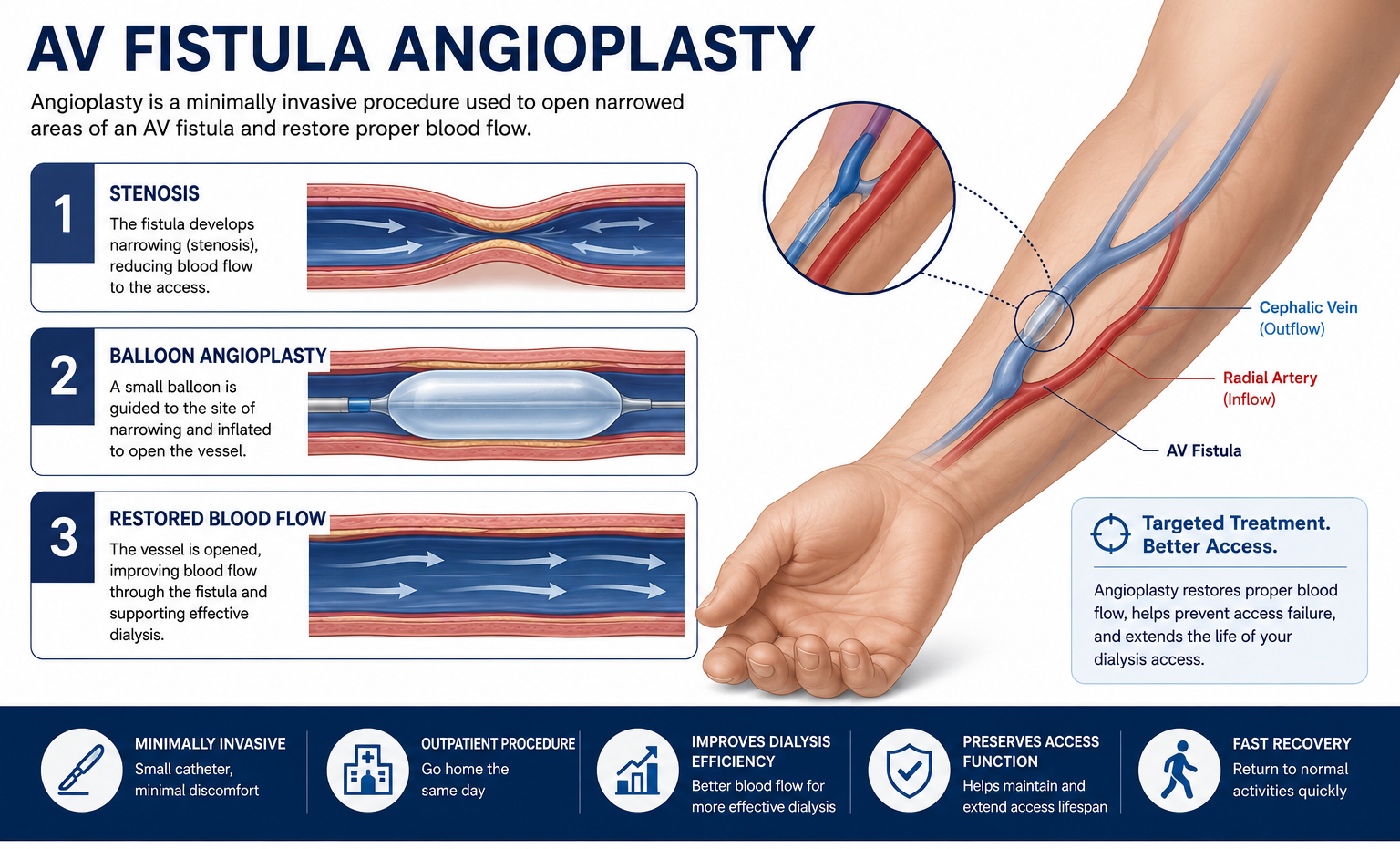
Dialysis Access Angioplasty is a minimally invasive procedure used to treat narrowing (stenosis) within a dialysis fistula, graft, or associated veins. The procedure restores adequate blood flow by using a small balloon to widen the narrowed section of the blood vessel, helping to maintain effective dialysis treatments and prolong the life of the access site.
Dialysis access angioplasty is one of the most common procedures performed to preserve and improve the function of hemodialysis access.
Why Dialysis Access Angioplasty Is Performed
Your healthcare provider may recommend dialysis access angioplasty if you have:
- Narrowing (stenosis) within a fistula or graft
- Reduced blood flow during dialysis
- Elevated dialysis machine pressures
- Difficulty achieving adequate dialysis treatments
- Prolonged bleeding after dialysis needle removal
- Swelling in the arm, hand, shoulder, or neck
- Changes in the thrill or bruit of the access
- Recurring access dysfunction
- Abnormal findings on a fistulogram or ultrasound evaluation
The procedure helps restore proper blood flow and prevent access failure.
How the Procedure Works
Before the Procedure
Preparation may include:
- Review of your medical history and medications
- Physical examination of the dialysis access
- Imaging studies such as a fistulogram or ultrasound
- Blood tests if needed
- Discussion of allergies, particularly to contrast dye
- Placement of an intravenous (IV) line if necessary
The procedure is usually performed in an outpatient vascular center, interventional radiology suite, or hospital.
During the Procedure
- The patient lies comfortably on an examination table.
- The dialysis access area is cleaned and sterilized.
- Local anesthesia is administered to numb the treatment area.
- A small catheter is inserted into the fistula or graft.
- Contrast dye is injected to identify the narrowed segment.
- A guidewire is advanced through the narrowed area.
- A specialized balloon catheter is positioned within the stenosis.
- The balloon is inflated to widen the blood vessel and improve blood flow.
- Additional balloon inflations may be performed as needed.
- Final imaging confirms successful treatment and improved circulation.
- The catheter is removed, and pressure is applied to the access site.
The procedure typically takes 30 to 90 minutes.
What to Expect During the Procedure
- You will remain awake throughout the procedure.
- Mild sedation may be provided if needed.
- Most patients experience minimal discomfort.
- You may feel temporary pressure when the balloon is inflated.
- A brief warm sensation may occur when contrast dye is injected.
- Vital signs are continuously monitored.
Most patients tolerate the procedure very well.
Benefits of Dialysis Access Angioplasty
- Restores blood flow through the dialysis access
- Improves dialysis efficiency
- Relieves narrowing within the fistula or graft
- Helps prevent access failure
- Minimally invasive treatment
- Avoids or delays the need for surgical revision
- Short recovery time
- Outpatient procedure in many cases
- Can significantly extend the lifespan of dialysis access
After the Procedure
Following angioplasty:
- You will be monitored for a short recovery period.
- Mild soreness or bruising at the access site may occur.
- Most patients return home the same day.
- The access is often available for dialysis shortly after treatment.
- Follow-up evaluations may be scheduled to monitor blood flow and access function.
- Your dialysis team will provide guidance regarding your next dialysis session.
Your physician will discuss any additional recommendations based on the procedure findings.
Risks and Safety
Dialysis access angioplasty is generally considered safe, but potential risks include:
- Bruising or bleeding at the access site
- Infection
- Blood vessel injury
- Temporary swelling
- Allergic reaction to contrast dye
- Blood clot formation
- Recurrent narrowing of the treated vessel
- Access site rupture requiring additional treatment
- Need for repeat procedures over time
Serious complications are uncommon when performed by experienced specialists.
Understanding Your Results
Successful dialysis access angioplasty may result in:
- Improved blood flow through the fistula or graft
- Better dialysis treatment efficiency
- Lower dialysis machine pressures
- Reduced arm swelling
- Improved thrill and bruit within the access
- Longer lifespan of the dialysis access
- Reduced risk of access thrombosis and failure
Regular monitoring remains important because narrowing can recur over time.
Frequently Asked Questions
What causes narrowing in a dialysis access?
Over time, scar tissue and changes within the blood vessel can cause narrowing, reducing blood flow through the fistula or graft.
Is dialysis access angioplasty painful?
Most patients experience only mild discomfort. Local anesthesia is used, and sedation may be provided when appropriate.
How long does the procedure take?
Most procedures take between 30 and 90 minutes, depending on the complexity of the narrowing being treated.
Will I need more than one angioplasty?
Possibly. Some patients develop recurrent narrowing and may require additional treatments to maintain optimal access function.
Can I receive dialysis after the procedure?
In many cases, the access can be used for dialysis shortly after treatment. Your physician and dialysis team will provide specific recommendations.
Schedule a Consultation
If you are experiencing reduced dialysis efficiency, prolonged bleeding, swelling, or other signs of dialysis access dysfunction, dialysis access angioplasty may help restore blood flow and preserve your fistula or graft. Contact our team today to schedule a consultation and learn more about maintaining a healthy, functioning dialysis access.