
Declot Procedures
Declot Procedures are minimally invasive treatments used to remove blood clots from a dialysis fistula, graft, or associated veins when the access becomes blocked. A clot can prevent adequate blood flow, making dialysis difficult or impossible. Declot procedures help restore function to the dialysis access, allowing patients to continue receiving life-sustaining dialysis treatments without the need for creating a new access site.
These procedures are commonly performed using specialized catheter-based techniques and can often be combined with angioplasty to treat the underlying cause of the clot.
Why Declot Procedures Are Performed
Your healthcare provider may recommend a declot procedure if you have:
- A clotted dialysis fistula
- A clotted dialysis graft
- Sudden loss of blood flow through the access
- Absence of the normal thrill or vibration in the access
- Difficulty performing dialysis treatments
- Elevated dialysis machine pressures
- Repeated dialysis access dysfunction
- Swelling of the arm or surrounding area
- Reduced dialysis effectiveness caused by access blockage
The goal is to restore blood flow and preserve the existing dialysis access whenever possible.
How the Procedure Works
Before the Procedure
Preparation may include:
- Review of your medical history and medications
- Physical examination of the dialysis access
- Ultrasound or fistulogram evaluation
- Blood tests if needed
- Discussion of allergies, especially to contrast dye
- Placement of an intravenous (IV) line if necessary
The procedure is typically performed in an outpatient vascular center, interventional radiology suite, or hospital.
During the Procedure
- The patient lies comfortably on an examination table.
- The dialysis access area is cleaned and sterilized.
- Local anesthesia is administered to numb the treatment area.
- A catheter is inserted into the fistula or graft.
- Contrast dye is injected to identify the clot and any areas of narrowing.
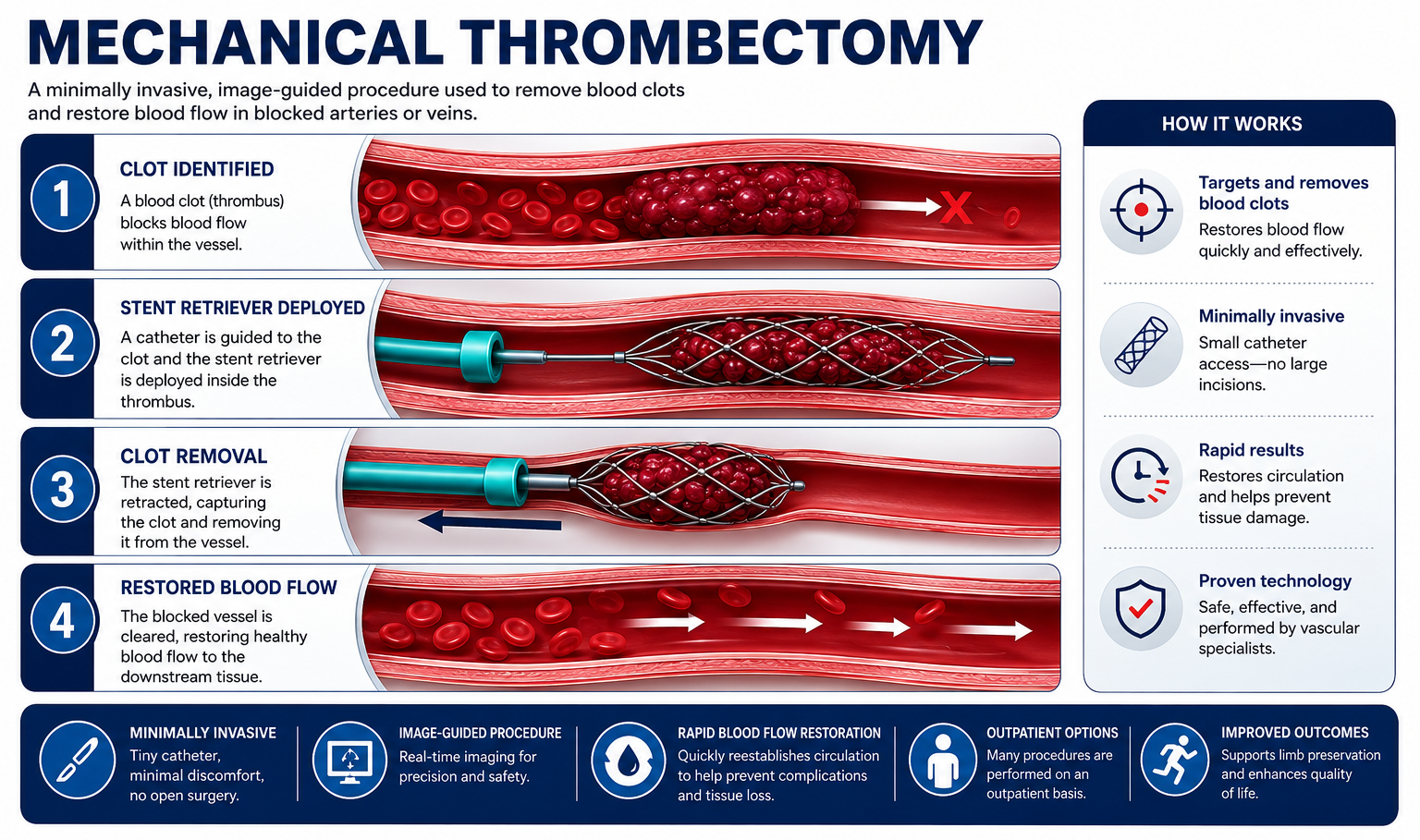
- Specialized devices are used to break up, remove, or dissolve the clot.
- Blood flow is restored through the access circuit.
- Balloon angioplasty is often performed to treat underlying narrowing that contributed to clot formation.
- Additional imaging confirms successful clot removal and improved circulation.
- The catheter is removed and the access site is closed.
The procedure generally takes 1 to 2 hours, depending on the size and complexity of the clot.
Types of Declot Techniques
Several methods may be used to restore dialysis access function, including:
- Mechanical Thrombectomy – devices physically remove or break apart the clot
- Pharmacomechanical Thrombectomy – combines clot-dissolving medication with mechanical clot removal
- Thrombolysis – medication is used to dissolve the clot
- Balloon Angioplasty – widens narrowed vessels contributing to clot formation
- Aspiration Thrombectomy – suction-based devices remove clot material
Your physician will determine the most appropriate treatment based on the condition of the access.
What to Expect During the Procedure
- You will remain awake throughout the procedure.
- Mild sedation may be provided for comfort.
- Most patients experience minimal discomfort.
- You may feel temporary pressure during catheter manipulation.
- A brief warm sensation may occur when contrast dye is injected.
- Vital signs are continuously monitored.
Most patients tolerate the procedure very well.
Benefits of Declot Procedures
- Restores blood flow through the dialysis access
- Allows continuation of dialysis treatments
- Preserves existing fistulas and grafts
- Minimally invasive alternative to surgery
- Rapid restoration of access function
- Short recovery time
- Outpatient treatment in many cases
- Can identify and treat underlying narrowing
- Helps avoid the need for a new access site
After the Procedure
Following a declot procedure:
- You will be monitored during a short recovery period.
- Mild bruising, swelling, or soreness at the access site may occur.
- Most patients return home the same day.
- The dialysis access is often available for use shortly after treatment.
- Follow-up evaluations may be recommended to monitor access function.
- Your dialysis team will provide guidance regarding future dialysis sessions.
Your physician will discuss any additional treatment or monitoring that may be needed.
Risks and Safety
Declot procedures are generally considered safe, but potential risks include:
- Bleeding at the access site
- Bruising or swelling
- Infection
- Blood vessel injury
- Recurrent clot formation
- Allergic reaction to contrast dye
- Access rupture requiring additional treatment
- Migration of clot fragments
- Need for repeat procedures over time
Serious complications are uncommon when performed by experienced specialists.
Understanding Your Results
Successful declot treatment may result in:
- Restoration of blood flow through the fistula or graft
- Return of a normal thrill or vibration in the access
- Improved dialysis efficiency
- Reduced dialysis machine pressure issues
- Preservation of the existing access site
- Improved long-term dialysis access function
Because clotting is often caused by underlying narrowing, ongoing monitoring is important to maintain access health.
Frequently Asked Questions
What causes a dialysis access to clot?
Clots often develop when narrowing within the fistula, graft, or veins reduces blood flow. Left untreated, the narrowing can eventually lead to complete blockage.
Is a declot procedure painful?
Most patients experience only mild discomfort. Local anesthesia and sedation help keep the procedure comfortable.
How long does the procedure take?
Most declot procedures take approximately 1 to 2 hours, depending on the complexity of the blockage.
Can my dialysis access be used afterward?
In many cases, the access can be used for dialysis shortly after the procedure. Your physician and dialysis team will provide specific instructions.
Can the access clot again?
Yes. Dialysis accesses can develop recurrent narrowing or clotting over time. Regular monitoring and timely treatment can help reduce this risk.
Schedule a Consultation
If your dialysis fistula or graft has become blocked, or if you are experiencing reduced blood flow, difficulty during dialysis, or loss of access function, a declot procedure may help restore circulation and preserve your dialysis access. Contact our team today to schedule a consultation and learn more about maintaining a healthy, functioning dialysis access.