
Fistulogram
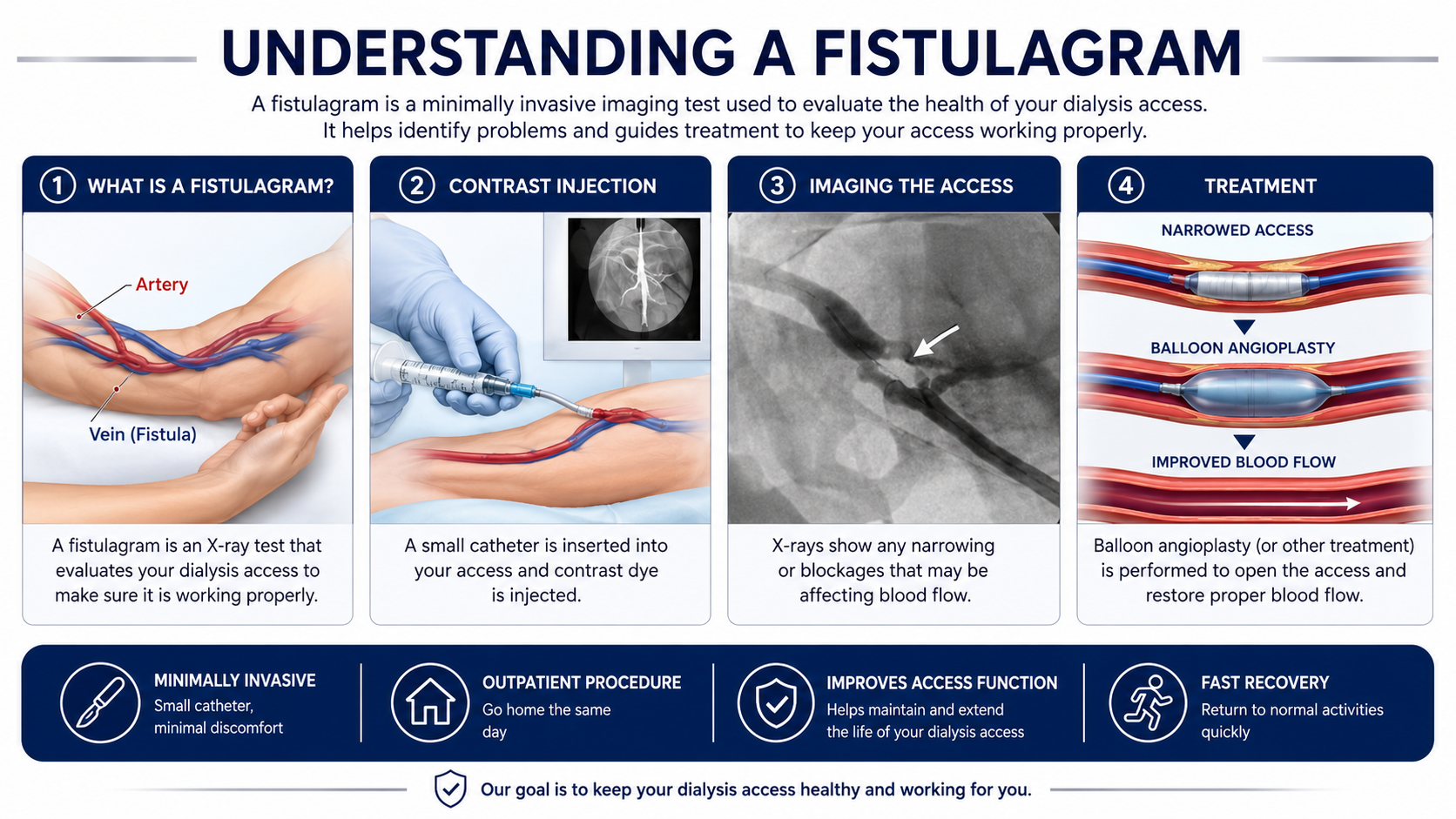
A Fistulogram is a minimally invasive imaging procedure used to evaluate the function and condition of a dialysis access fistula or graft. By injecting contrast dye into the access site and obtaining real-time X-ray images, physicians can identify narrowing (stenosis), blockages, blood clots, or other abnormalities that may interfere with effective dialysis treatment.
A fistulogram is an important diagnostic tool for maintaining the health and performance of dialysis access and can often be combined with treatment during the same procedure if a problem is found.
Why a Fistulogram Is Performed
Your healthcare provider may recommend a fistulogram if you have:
- Difficulty during dialysis treatments
- Reduced blood flow through a fistula or graft
- Prolonged bleeding after dialysis needle removal
- Swelling in the arm, neck, or hand
- Elevated dialysis machine pressures
- Poor dialysis efficiency
- Suspected narrowing or blockage of the access site
- Clotted dialysis access
- Changes in the thrill or bruit of the fistula
- Need for routine evaluation of dialysis access function
The procedure helps identify problems early and preserve long-term dialysis access.
How the Procedure Works
Before the Procedure
Preparation may include:
- Review of your medical history and medications
- Physical examination of the dialysis access
- Blood tests if needed
- Discussion of allergies, particularly to contrast dye
- Temporary adjustment of certain medications if instructed
- Placement of an intravenous (IV) line if necessary
The procedure is typically performed in an outpatient vascular center, interventional radiology suite, or hospital.
During the Procedure
- The patient lies comfortably on an examination table.
- The dialysis access area is cleaned and sterilized.
- Local anesthesia is administered to numb the access site.
- A small needle or catheter is inserted into the fistula or graft.
- Contrast dye is injected into the access circuit.
- Real-time X-ray images are obtained as the dye flows through the blood vessels.
- The physician evaluates the fistula, graft, and associated veins for narrowing, blockage, or other abnormalities.
- If a problem is identified, treatment such as angioplasty or thrombectomy may be performed during the same session.
- Final imaging confirms the results.
- The catheter is removed, and pressure is applied to the access site.
The procedure typically takes 30 to 60 minutes, although additional treatment may extend the procedure time.
What to Expect During the Procedure
- You will remain awake throughout the procedure.
- Mild sedation may be provided if needed.
- Most patients experience minimal discomfort.
- A brief warm sensation may occur when contrast dye is injected.
- The dialysis access site is carefully monitored throughout the procedure.
- Vital signs are continuously observed.
Most patients tolerate the procedure very well.
Benefits of a Fistulogram
- Provides detailed evaluation of dialysis access
- Identifies narrowing and blockages early
- Helps prevent access failure
- Improves dialysis efficiency
- Minimally invasive procedure
- Can diagnose and treat problems during the same visit
- Helps extend the lifespan of fistulas and grafts
- Short recovery time
- Outpatient procedure in many cases
After the Procedure
Following a fistulogram:
- You will be monitored for a short recovery period.
- Mild soreness or bruising at the access site may occur.
- Most patients return home the same day.
- Normal activities can often be resumed within 24 hours.
- Your dialysis team may provide specific instructions regarding your next treatment session.
- Follow-up appointments may be recommended depending on the findings.
Your physician will discuss the results and any additional treatment recommendations.
Risks and Safety
A fistulogram is generally considered safe, but potential risks include:
- Bruising or bleeding at the access site
- Infection
- Allergic reaction to contrast dye
- Blood vessel injury
- Temporary discomfort or swelling
- Blood clot formation
- Contrast-related kidney concerns in certain patients
- Need for additional procedures if significant abnormalities are found
Serious complications are uncommon when the procedure is performed by experienced specialists.
Understanding Your Results
A fistulogram may reveal:
- Normal fistula or graft function
- Narrowing (stenosis) within the access circuit
- Blood clots or thrombosis
- Venous outflow obstruction
- Central vein narrowing
- Access-related aneurysms
- Reduced blood flow affecting dialysis performance
- Need for angioplasty, thrombectomy, or other interventions
The findings help your physician determine the best approach for maintaining a healthy and functional dialysis access.
Frequently Asked Questions
What is the difference between a fistulogram and an angiogram?
A fistulogram specifically evaluates a dialysis fistula or graft and the associated veins, while an angiogram is a broader imaging study used to evaluate arteries and blood vessels throughout the body.
Is a fistulogram painful?
Most patients experience only mild discomfort. Local anesthesia is used to numb the access site, and sedation may be provided if needed.
How long does the procedure take?
Most fistulograms take approximately 30 to 60 minutes, although additional treatment may increase the procedure time.
Can treatment be performed during the same procedure?
Yes. If narrowing, blockage, or other problems are identified, angioplasty or other interventions can often be performed immediately.
When can I use my dialysis access again?
In many cases, the access can be used for dialysis shortly after the procedure. Your physician and dialysis team will provide specific guidance.
Schedule a Consultation
If you are experiencing dialysis access problems, reduced treatment efficiency, prolonged bleeding, swelling, or other concerns related to your fistula or graft, a fistulogram can help identify the cause and guide effective treatment. Contact our team today to schedule a consultation and learn more about maintaining healthy dialysis access.